
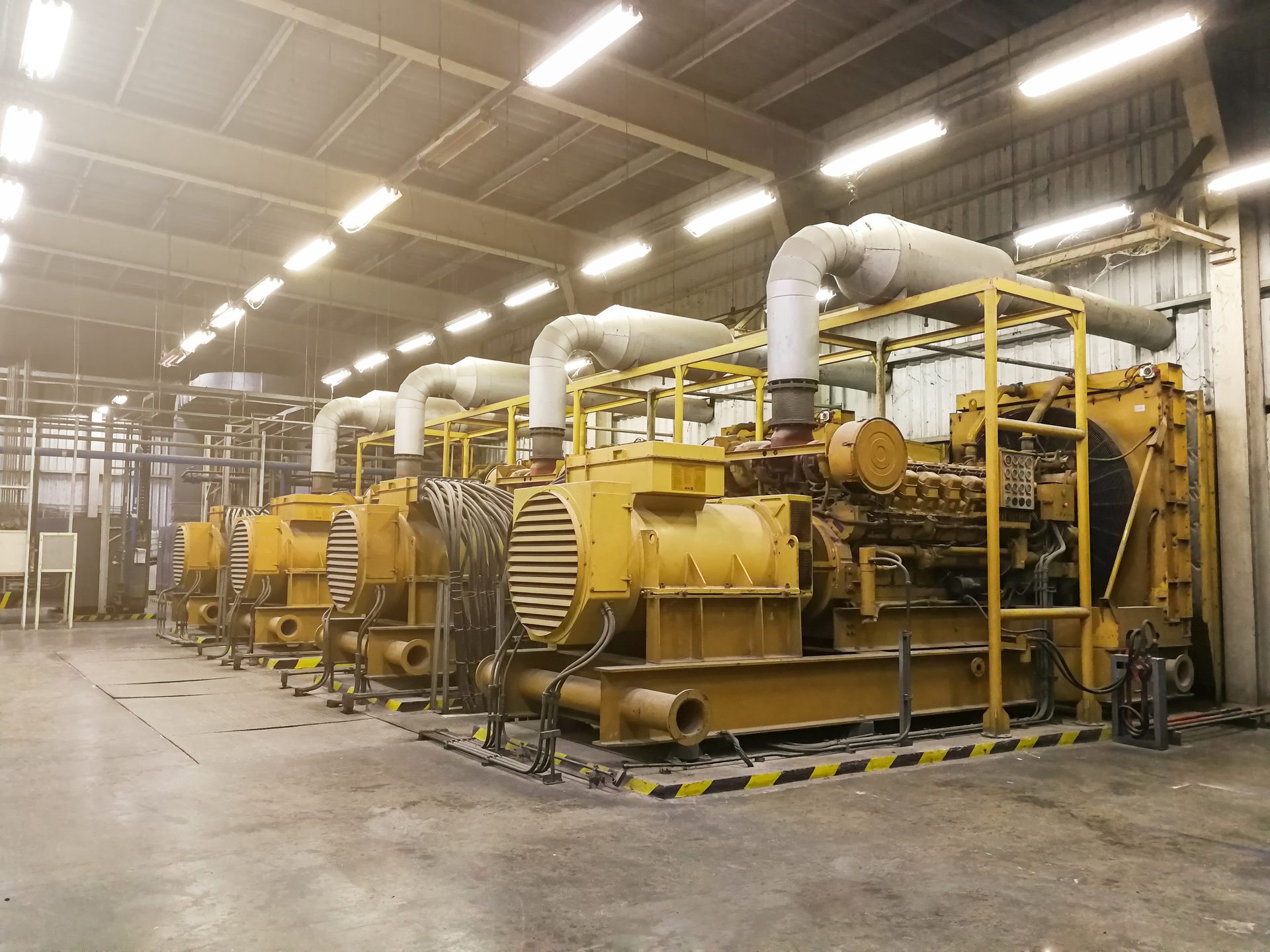
Continuous on-site generation for facilities where the grid isn’t enough. Carter engineers have supported prime power projects from multi-MW data center campuses to remote industrial operations.
Facilities choose prime power when the utility alone cannot support what the operation requires.
Remote sites, new developments without grid infrastructure, or locations where utility extension costs exceed on-site generation economics. Mining operations, oil and gas facilities, and greenfield industrial sites often fall into this category.
The local utility cannot deliver the capacity the facility needs, or grid reliability does not meet operational requirements. Data centers with aggressive deployment timelines and heavy industrial users frequently encounter this constraint.
When demand charges, time-of-use rates, or long-term energy costs make on-site generation more economical than utility power. Cogeneration and combined heat and power configurations can further improve the financial case.
Prime power plants are engineered for continuous duty. Unlike standby systems that run only during outages, prime installations operate around the clock and must be designed accordingly.
Continuous operation demands a reliable and well-managed fuel supply chain. Fuel systems for prime power go well beyond a day tank and a fill connection.
Prime power systems can operate in several modes depending on the facility’s relationship with the utility grid and operational requirements.
Carter engineers evaluate site conditions, utility tariffs, and operational goals to recommend the optimal operating strategy.
Prime power projects require front-end engineering that accounts for continuous duty cycles, growth projections, and regulatory requirements.
Continuous-duty generators accumulate operating hours rapidly. A structured maintenance program is essential to reliability and cost control over the life of the asset.
Combined heat and power systems capture thermal energy from generator exhaust and cooling circuits to produce usable heat, steam, or chilled water. For facilities with simultaneous power and thermal loads, CHP can push overall fuel efficiency above 80%, substantially reducing operating costs compared to separate generation and heating systems.
Applications include industrial process heat, campus heating and cooling, and greenhouse or agricultural operations where both electricity and thermal energy are consumed continuously.
Microgrids combine generators with renewable sources such as solar or wind, battery energy storage, and intelligent controls to create a self-managing power system. These hybrid configurations can reduce fuel consumption, lower emissions, and improve resilience by diversifying energy sources.
Carter engineers design microgrid systems that integrate CAT generator sets with third-party renewables and storage, providing a single point of accountability for the complete power plant.
Prime power is not a product you install and walk away from. These systems run continuously, accumulate hours quickly, and require a service partner who understands the difference between a standby generator that exercises once a month and a prime-rated plant that operates 8,760 hours a year.
Carter supports prime power installations from initial engineering through decades of operation. Our field service teams, parts inventory, remote monitoring infrastructure, and overhaul capabilities are built around the demands of continuous-duty equipment. When a unit needs attention, response time and technical expertise matter — and that is the foundation of the Carter service relationship.
From the first site visit through every major overhaul, the same engineering and service organization stays with the project. That continuity is what separates a vendor from a partner.
A hyperscale data center operator required continuous on-site generation to supplement constrained utility capacity during a phased campus buildout. Carter engineered a paralleled generator plant with grid-parallel capability, allowing the facility to operate on self-generated power while maintaining utility as a backup source.
A manufacturing facility located beyond economical utility reach required a self-contained power plant to support continuous process loads. Carter designed and installed an island-mode generation system with on-site fuel storage and automated controls to deliver uninterrupted power without any grid connection.